Pill Text
Pill Text
Pill Text
Pill Text

april’s Expert Filing experience is designed to support high-net-worth clients with complex financial lives, covering multiple business entities, K-1s from investment partnerships, and intricate estate planning structures.
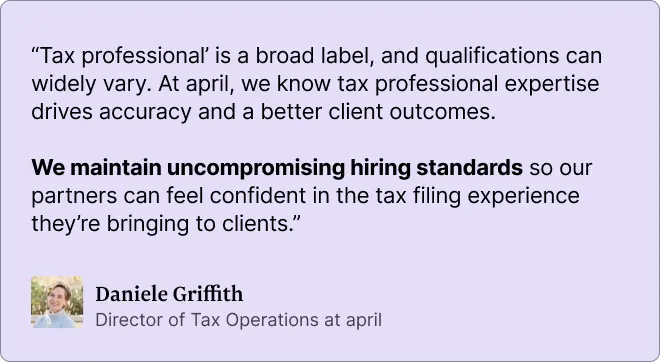
We know that the difference between a competent professional tax filing experience and an exceptional one often comes down to the expertise of the person actually preparing the return, which is why we maintain the highest tax professional hiring standards in the industry.
The hidden risk with most "professional" tax preparation services
Did you know anyone can call themselves a tax professional? It’s true - there’s no federal testing requirement to prepare tax returns. As long as someone has an IRS-issued PTIN, they can call themselves a “professional” and prepare tax returns for a fee, even without passing a national exam or holding a professional license.
For wealth management firms with high-net-worth clients, or business platforms serving SMBs, relying on uncredentialed and/or inexperienced tax professionals can create unacceptable risk. An improperly allocated K-1, a missed state filing requirement, or an incorrectly calculated business deduction can trigger audits, penalties, and damaged client relationships.
Bottom line: the term “tax professional” isn’t a consistent standard, so when selecting a tax filing service, it’s important to verify what credentials and experience are actually behind the label.
april’s industry-leading hiring standards
At april, we recognize that the professional filing experience is directly impacted by the quality of the tax professional preparing the return. Complex filings have more opportunities for error, and more severe consequences when those errors occur.
To ensure april’s partners are able to deliver a premium filing service, we’ve established the highest tax professionals hiring standards in the industry, requiring every single april tax professionals to have:
Nationally recognized credentials: All april tax professionals are either a Certified Public Accountant (CPA) or an Enrolled Agent (EA).This means they’ve completed a rigorous series of exams focused on taxation and must meet continuing education requirements to maintain their credentials.
A minimum of 5 years of experience: We require each tax professional to have at least 5 years of hands-on tax preparation experience, ensuring they have matured from merely applying rules and following procedures, to recognizing opportunities and anticipating complications.
Proven ability in handling complexity & managing client relationships: We believe that experience alone isn't enough. Every tax professional we hire is U.S. based, thoroughly vetted by our team, and required to demonstrate expertise in handling the complex scenarios clients encounter including Schedule C, business entities, K-1, multistate, and more.
A deeper dive into Enrolled Agents
When most people think of tax professionals, they think of CPAs. If you or your clients haven't heard of Enrolled Agents (EAs), you're not alone. EAs are federally licensed tax practitioners authorized by the U.S. Treasury Department - and the tax profession’s best-kept secret.
To become an EA, candidates must pass a comprehensive, 3-part IRS Special Enrollment Examination (SEE), which covers individual taxation, business taxation, representation, practices, and procedures. Similar to the CPA exam, the SEE requires hundreds of hours of study and tests both breadth of knowledge and depth of understanding in complex tax scenarios. EAs hold unlimited practice rights before the IRS, meaning they can represent taxpayers in any tax matter, before any IRS office in the country.
In terms of IRS representation authority, EAs stand on equal footing with CPAs and tax attorneys. The key difference between EAs and CPAs lies in specialization. While a CPA's education and examination covers accounting, auditing, business law and financial reporting, alongside taxation, EAs specialize exclusively in tax. They've dedicated their professional development entirely to understanding the Internal Revenue Code, IRS procedures, and taxpayer representation.
Both CPAs and EAs bring exceptional expertise to tax preparation, with up-to-date mastery of tax law through mandatory continuing education of at least 72 hours every three years. Whether an april CPA or EA prepares your client's return, you can be confident the april tax professional has both the proven expertise and up-to-date knowledge to handle the most complex tax situations.
In conclusion
The risks inherent in professional tax filing escalate exponentially with complexity. By requiring CPA or EA credentials, a minimum of five years of experience, and demonstrated expertise in complex tax scenarios, we ensure that every return is prepared by an experienced tax professional that is capable of handling any tax situation with accuracy, clarity, and professionalism. april's rigorous hiring standards aren't just a differentiator; they’re the cornerstone of our Professional Tax Filing experience, enabling wealth management and SMB platforms to extend their premium service offerings with complete confidence that their clients will receive the exceptional expertise they expect and deserve.



Related Content
Related Content
Related Content
Related Content
There's more where this came from